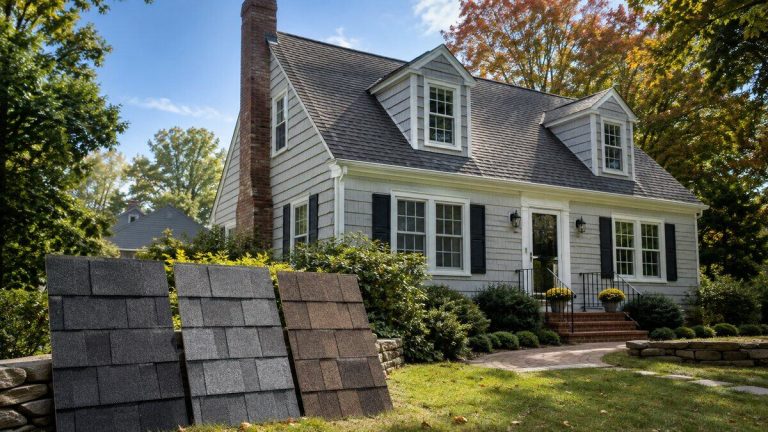

The best roof shingle color is the one you approve on your actual home, in more than one light condition, after the roofing product and system requirements are settled. A small swatch can help create a shortlist, but it cannot show how a blended shingle will read across a full roof or beside siding, trim, masonry, gutters, and nearby trees.
For a Massachusetts homeowner planning a roof installation or replacement, color should be a documented project decision—not a last-minute choice made from a phone screen. This guide gives you a repeatable way to compare roof shingle color options without turning personal taste into a universal rule.
Start with the roof system that fits the written scope. Confirm the manufacturer, product line, shingle style, required accessories, warranty documents, and any project-specific performance criteria. Then compare the colors that are actually available within that approved product.
This order prevents a common planning problem: choosing a favorite color first and later discovering that it is not available in the product line, warranty package, or delivery window under consideration. Roof Experts’ comparison of roof shingle types for Massachusetts homes is the established starting point for the broader product decision. The narrower task here is choosing color after the product choices have been reduced responsibly.
Begin with the parts of the property that are least likely to change. Brick, stone, fixed metalwork, and large areas of masonry usually outlast a paint color. Siding and trim matter too, but they may be easier to repaint or replace during the life of the roof.
Do not try to match every color exactly. Look for a shared undertone or a deliberate contrast. A roof blend that contains warm brown notes may relate differently to red brick than a flat cool gray. A charcoal blend may appear nearly black in shade but show more variation in direct light. These are visual observations to test with the real sample, not rules that guarantee a good result.
| Exterior cue | What to compare | Decision checkpoint |
|---|---|---|
| Brick or stone | Warm, cool, or mixed undertones; amount of visible color variation | Does the shingle relate to the permanent material without trying to copy it exactly? |
| Siding | Overall contrast from the street and whether the roof feels too dominant | Would the choice still work if the siding were repainted within the same general family? |
| Trim, gutters, and metal accents | Whether the roof blend connects to or intentionally separates from these smaller elements | Are you comparing the actual installed colors rather than a catalog name? |
| Roof size and pitch | How much of the roof is visible and how strongly a pattern reads over a large plane | Have you viewed a full-size sample or an installed example from a normal ground-level distance? |
| Neighborhood or association rules | Recorded restrictions, approval steps, and nearby permanent context | Is required approval complete before materials are ordered? |
| Future exterior plans | Paint, siding, trim, or addition plans already likely during the roof’s service life | Does the roof leave reasonable flexibility for those known changes? |
GAF’s shingle color guide notes that computer and smartphone screens can represent colors differently and recommends seeing physical samples. Use an online visualizer to narrow the field, not as the final approval.
If an installed example is available, confirm the exact manufacturer, product line, and color before relying on it. Similar marketing names do not prove two shingles are the same blend.
Architectural shingles often combine several tones and shadow lines. The visible result depends on the blend, the roof plane, viewing distance, sunlight, and surrounding materials. Ask to see how the candidate looks both close enough to understand the blend and far enough away to approximate the finished roof.
Also look at every prominent elevation. A sample that works against front-facing brick may feel different beside siding on a rear addition. If two roof sections meet, confirm whether the same product and color will cover both or whether an existing section will remain.
A lighter appearance does not by itself establish how a specific roofing product will perform. The U.S. Department of Energy’s cool-roof guidance explains that reflective roof surfaces are intended to stay cooler in sunlight. If energy performance is part of your goal, compare the exact product’s published properties and the rest of the roof-and-attic assembly instead of assuming a color name proves a result.
Roof Experts’ whole-system energy-efficient roofing checklist separates roof-surface choices from air sealing, insulation, ventilation, and moisture-control questions. Keep those technical decisions in their own column; keep the color approval focused on the appearance you can verify.
The final approval should identify the manufacturer, product line, exact color name or code, and the sample or document used for confirmation. Put that information in the contract, selection sheet, or approved change record before materials are ordered.
Use this final checkpoint:
If you are replacing an existing roof, start with Roof Experts’ roof replacement service and bring your exterior photos, known restrictions, and two or three sample candidates to the estimate. For a new assembly, the company’s roof installation service provides the relevant project path.
A careful roof shingle color decision ends with an exact written selection, not a general description such as “dark gray” or “weathered brown.” Approve the product, test the physical sample on the real home, and preserve the final name and code before ordering.
Roof Installations
Roof Replacements
Roof Repairs